

Every now and then I read something that doesn’t necessarily change what I think, but gives me better words for something I have been thinking about for a long time. Zetsu Nawa’s Artwashing Kinbaku: How Erotic Bondage Becomes Rope Art did exactly that. Most obviously, it gave me a new very useful word: artwashing.
Artwashing kinbaku
This is what I took from Zetsu’s article, his argument is not that kinbaku cannot be art. He makes quite clear that it can be artistic, beautiful and aesthetically sophisticated. His argument is about what can happen when we need it to be art.
Calling kinbaku “the Japanese art of rope bondage” seems complimentary. But it can also make something uncomfortable a lot easier to present. The rope remains, the beautiful body remains, composition, movement, vulnerability and connection remain. But bondage, sex, pornography, domination, pain, humiliation, cruelty and desire can quietly disappear from the story. That is the artwashing Zetsu describes.
He traces the same process through the history we tell about kinbaku. There is a comfortable version in which modern kinbaku descends from hojōjutsu (the restraint techniques of the samurai ) and gradually develops into the sophisticated Japanese rope art we practice today. The actual history is much messier. Hojōjutsu certainly contributed to it, but modern kinbaku also developed through erotic illustration, photography, theater, magazines, live performance, pornography and Japanese SM culture. That isn’t an unfortunate part of its history that we need to look past, it is part of the history.
Zetsu spends considerable attention on the postwar erotic magazines in which modern kinbaku developed. Photography, illustration, fantasy, technique, reader contributions and pornography existed alongside one another. These weren’t just places where an emerging art happened to be published. They were part of the environment and community in which the practice itself developed.
Artwashing isn’t only about rewriting history. Zetsu points to the language we use today: connection, energy, ritual, trust, movement. None of those experiences is necessarily false. There can be enormous connection in rope. But when someone is being restrained, exposed, controlled, hurt or made helpless and we describe what is happening exclusively as an “exploration of human connection”, something has disappeared from the description. The uncomfortable parts have become respectable.
One of the things I particularly appreciate about Zetsu’s article is that he doesn’t try to solve this by arguing that kinbaku therefore isn’t art. That would merely create another artificial boundary. Kinbaku can be beautiful, artistic, pornographic, commercial, intimate, sadistic, theatrical and sexually explicit at the same time. It doesn’t need to be moved from one category into another. It doesn’t need to become respectable to become valuable.
I cannot do justice to the complete historical argument here in a few paragraphs, so I recommend reading Zetsu’s original article. What I have written above is what I took from it.
And then it made me think about RopeMarks
Not because I think something is missing from Zetsu’s argument, the contrary, he makes the argument about artwashing very well. It simply sent my thoughts somewhere else. If we don’t need art to legitimize kinbaku, what is it that I consider important when I talk about kinbaku? And that brought me back to something I have said in workshops for years:
| Japanese bondage is one of the few things in erotica that is a skill.
It is deliberately a little provocative. Obviously there are skills involved in many erotic practices. What I mean is that learning Japanese bondage requires acquiring and maintaining a substantial physical craft.
- Rope handling.
- Placement.
- Tension.
- Anatomy.
- Structure.
- Timing.
- Body manipulation.
- Reading the person in your ropes.
- Understanding what changes when you move a body.
- Knowing when to continue, when to change something and when to stop.
Especially once we move towards more demanding bondage and suspension, these aren’t optional decorations around the experience. They are skills, and neither art nor connection makes bad rope good kinbaku. Being authentically erotic doesn’t do that either.
The finished picture is not the kinbaku
This is where the thought becomes particularly interesting to me. A beautiful suspension photograph is easy to understand. We see the ropes, the lines, the body and the final shape. But much of what I find interesting about kinbaku isn’t visible in that photograph.
How did she get there?
What happened when I moved her?
Did I give her space, take it away, expose her, compress her, challenge her?
What happened to the tension in the ropes and in her body?
What happened between us?
Was there anticipation? Resistance? Surrender? Fear? Pleasure? Frustration? Relief?
And did I have the skill to deliberately create, recognize and manage what was happening?
This has become increasingly explicit in how I teach rope. Instead of thinking only in terms of positions and ties, I increasingly think in transitions:
- floor → air
- open → compressed
- symmetric → twisted
- stable → moving
The position at the end matters, but so does the arrow, perhaps even more.
A photograph can show where we arrived.
Kinbaku also lives in how we got there.
For me, it remains bondage
So Zetsu’s article gave me artwashing, and a clearer way of thinking about why I have never felt a need to rescue kinbaku from the word bondage. But following that thought into my own rope leads me somewhere slightly different. I don’t need kinbaku to be art. I don’t need it to be pornography either. I don’t need it to be about connection, intimacy or sadism. It can be any or all of those things.
What I don’t want to lose underneath those descriptions is the physical practice itself. Kinbaku is also a learned craft. The finished shape is only one visible result of that process. Kinbaku can be art. It can be pornography. It can be beautiful, ugly, intimate, playful, cruel, sexual or performative. It doesn’t have to be all of those things every time. And none of those labels needs to legitimize it. At its core, it remains bondage: one person using rope, skill and intention to do something to and with another person’s body.
I am perfectly comfortable with that.
Zetsu Nawa’s Artwashing Kinbaku: How Erotic Bondage Becomes Rope Art
This article on Fetlife sparked some interesting comments
Kinbaku Today | RopeMarks workshops | RopeMarks
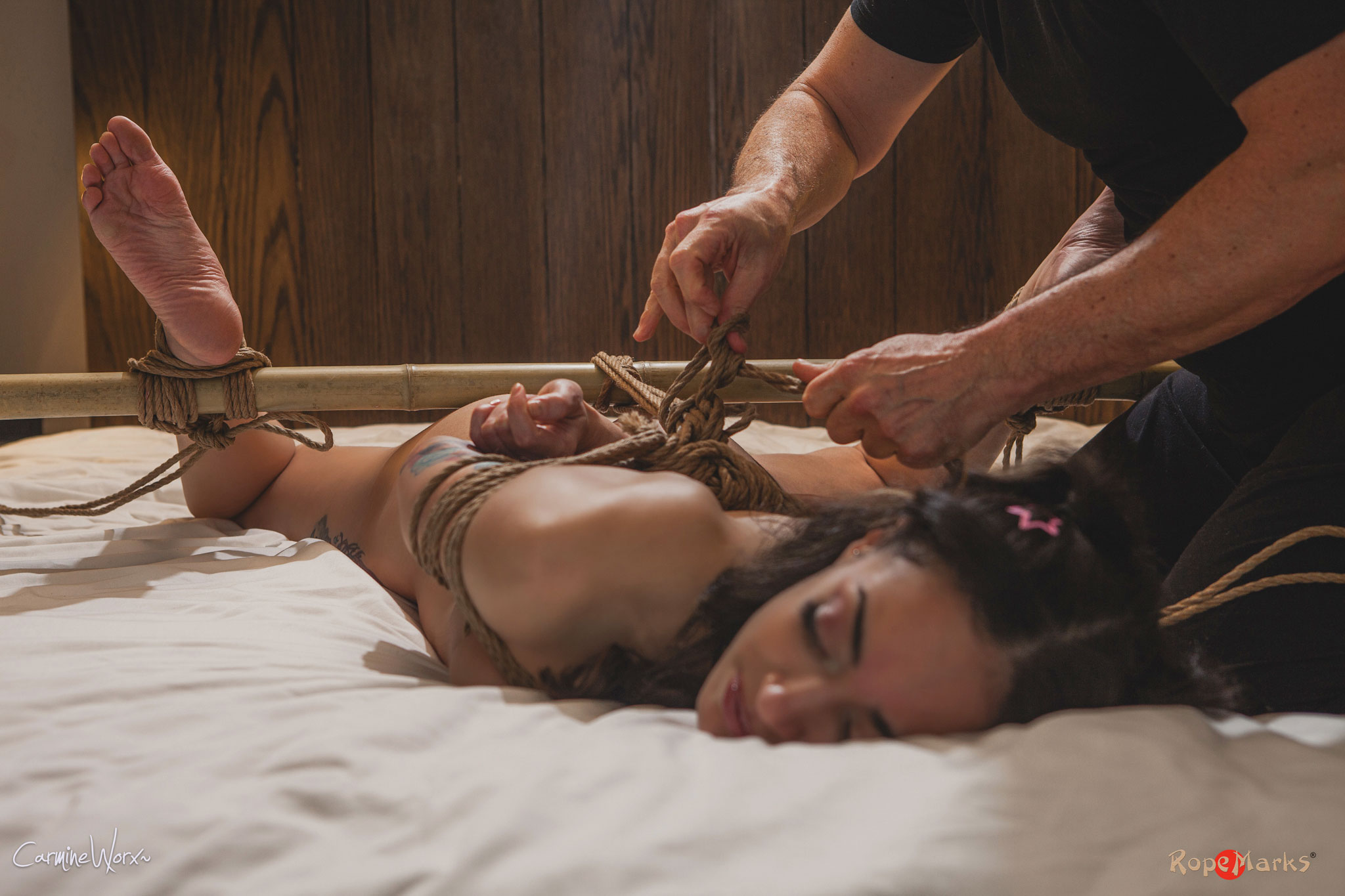
Featured image credits:
Model : RopeBaby
Photographer: CarmineWorx



Leave A Comment