

Japanese restraint terminology
Ishidaki (石抱き)
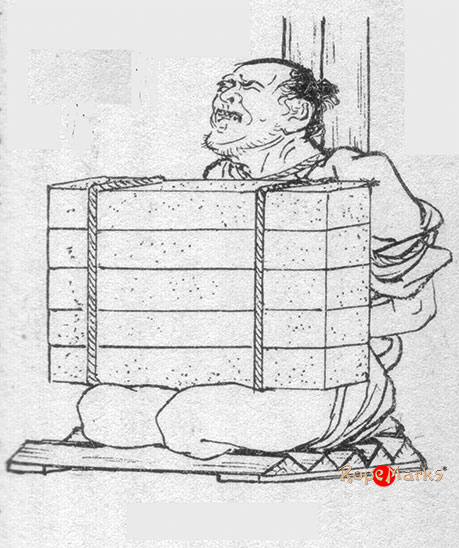
Ishidaki (石抱き), literally “stone hugging” or “stone embracing”, was a form of Japanese torture used during the Edo period. A restrained person was made to kneel on a ridged wooden board while heavy stones were stacked across their thighs, causing intense pressure and pain.
Japanese: 石抱き (also 石抱)
Reading: ishidaki
石 (ishi): stone
抱き (daki): embracing or holding
Also called: Ishi-zeme (石責め), Soroban-zeme (算盤責め)
Historical context: Edo-period judicial torture
Note: Ishidaki was historically a method of coercive interrogation, not a traditional Kinbaku tie. It is included in the RopeMarks glossary because of its relationship to Japanese restraint history and terminology.
How Ishidaki was used
During the Edo period, ishidaki was used to force confessions from people suspected of crimes.
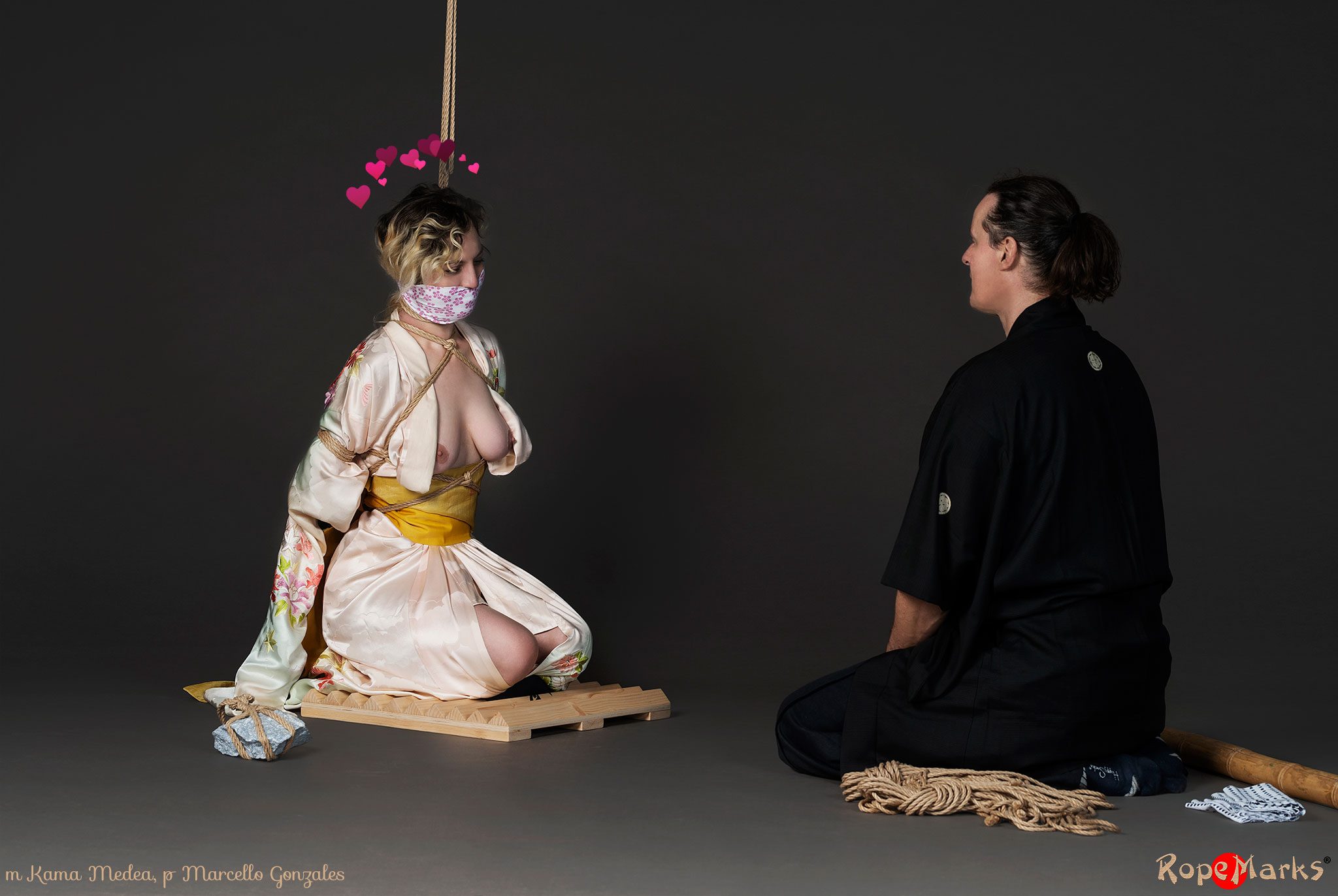
The person was restrained in a kneeling position on a wooden platform made from several triangular beams. Heavy, flat stones were then placed across the thighs, increasing the pressure on the legs against the ridged surface.
Historical descriptions refer to individual stones weighing approximately 45–50 kg, with multiple stones applied progressively. The exact total weight could vary, so there is no reliable basis for treating 250 kg as a standard starting load.
The combination of restraint, concentrated pressure and heavy weights made this an extremely painful and potentially injurious form of torture.
The Soroban board
The ridged wooden platform used in ishidaki was called a soroban board.
It consisted of several triangular wooden beams arranged side by side. Their raised edges concentrated pressure beneath the knees and lower legs when weight was applied.
The name soroban-zeme (算盤責め) refers to this platform and its resemblance to the form of a Japanese abacus.
The board is an important part of the historical method, rather than simply a surface on which the person knelt.
For more on the terminology, see Soroban.
Historical illustrations
Ishidaki in images
The following gallery illustrates ishidaki and the ridged soroban board associated with the practice.


Hi Max, The value is a guestimation from values I have found around the web on English language sites mentioning Ishidaki. If there are sources that can be considered (more) correct I will gladly adjust the text 🙂
Thank you very much for the swift reply! I’m sorry if my question was misleading: I did not mean to suggest that your text is wrong.
Hi Bob,
Just one question concerning a minor detail, namely how much weight was used: you mention the typical load to be at least 250kg, while other sources (eg the Japanese wiki) say that up to four stones of 45kg each were applied, so at most 180kg (of course still a lot!). Maybe different weights were used, for example depending on the gender of the prisoner? Or perhaps the standard load has changed over the years?
Kind regards, Max