


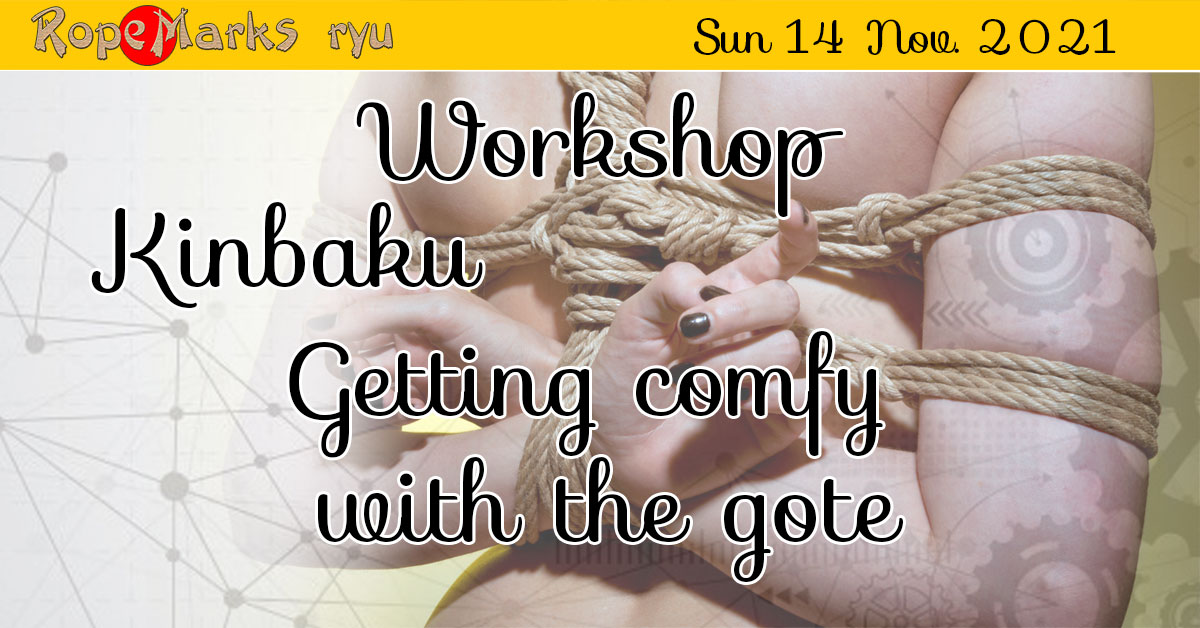
Kinbaku workshop
Getting comfy with the gote
When: 14 Nov. 2021, from 14.00 – 17.00.
Level: Beginner++ and intermediate.
Prerequisites: Tying a single and double column tie using a square knot is no problem for you.
Location: Amsterdam (Nieuw West).
Costs: € 95,- per couple.
This is a clothes on, non-sexual workshop, but no doubt you’ll be inspired to bring your new skills into your private intimate play at home. Please wear comfortable clothing and for the bunnies choose a tight fitting outfit.
Please sign up with the partner you’ll be tying with. You can sign up here!
About the gote and the workshop
Probably the most famous element of traditional Japanese bondage (kinbaku) is the gote. Basically ‘ushiro takate gote’ means: hands behind the back. The reason why this tie is so important is because the unwritten rule is that each kinbaku sessions starts with the hands behind the back. And although there are many technical gote recipes out there, there’s no such thing as ‘the’ gote. Or the ‘best’ gote. What the best gote is, will always depends on your intention for the play and on your own preferences for technique and aesthetics.
Two gote styles for endless variations
Now, to get both you and your bunny comfy with the gote, I’ll teach you two different styles for building up your gote’s. Although both of these might seem simple, there are many details to focus on. Where do you place your rope and why? How do you keep tension on the rope, how can you make adjustments? How can you play with aesthetics and of course: how do you connect and communicate with your model before, during and after play? To keep the workshop dynamic and playful we’ll also play with some interesting leg bondages that can be combined with the gote. This way you can immediately start experimenting with connecting the upper and lower body. Get ready for some fun in action!
What this workshop is not about
This is not a suspension workshop. I will show you briefly how to proceed from the gote to attaching the 4th rope that you need for suspensions, but: my vision is that you should first be completely comfortable with tying and untying the gote in floorwork. If you feel ready for a next step, you’re welcome to sign up for my follow up workshops.
For who?
This course is for you if tying a single and double column tie using a square knot is not a problem, but also if you want to refresh and solidify your kinbaku foundation.
Program
Topics that we will address are:
- Gote without stem,
- Gote with stem,
- Floorwork,
- Rope handling,
- Tension,
- Flow,
- Untying,
- Anatomy & safety,
- Communication.
Each topic will include safety information, details to improve your rope handling, specific techniques to improve your tying, tension, flow and to deepen the connection with your partner. During the workshop there’ll be plenty of room for experimenting and personal advice.
The topics are aimed at kinbaku foundations and can be upscaled when the level of the participants and the available time allows for this. With the simpler ties you can switch roles, with the more complex ties switching is not possible anymore.
The practicalities
In every workshop safety comes first. The location is approximately 80m2 and with a maximum of 8 couples we can keep enough distance from each other. The space we’re in has a powerful extraction system that completely refreshes the air every 7 minutes. On top of that we can open opposing windows for continuous fresh air.
This workshop will be held in the Dutch language, but if needed we switch to English.
Please come as a rigger and bunny couple (see FAQ).
Bring at least 6 pieces of rope, 8m in length, 6mm thick (see FAQ). If you need rope, follow this link: https://ropemarks.com/rope/.
We have coffee and tea. If you want something else to drink bring it in a bottle/container that you can close.
Should you like to participate but need a partner (model of rigger) please see our FAQ.
I want to participate
Great! Public registration opens 8 Oct. 2021 at 20:00 CET (That is 8 O’clock in the evening local Amsterdam, Netherlands time).
https://ropemarks.com/register/
[/timed-content-server]
https://ropemarks.com/register/
[/timed-content-server]
After your registration you will receive an email with further details about the location.
If you want to beat the queue for participating in future events consider subscribing to my mailing list. Subscribers get first opportunity to participate in our events.
Questions?
We have compiled a list, FAQ, of the most common questions. Is the answer to your question there?
No. You need to bring your own rope to the workshop.
If you need rope, you can order it from the RopeMarks rope shop. Please order at least one week in advance so there is enough time to prepare it.
The number of ropes you need depends on the workshop, so always check the event description first.
Some numbers that I found that work are:
4 ropes = beginners set
8 ropes = intermediate set
12 ropes = advanced set
15 ropes = you have elevated to the supreme level 🙂
Having a few shorter pieces rope in your rope-kit can come in handy, ie. 2m and 4m.
Suspension work generally requires more rope than floor work.
Switching roles during an exercise is not prohibited, but is usually not recommended. Most workshops do not allow enough time to repeat each exercise in both roles. If a workshop is suitable for switching, this will be mentioned in the event description. However, switching roles between exercises is generally fine, provided both partners meet the skill requirements for their respective roles.
A workshop registration is normally for two people attending together. The pair can be any combination of genders. If an event uses a different registration format, this will be stated in the event description.
For Japanese style bondage the general consensus is to use rope that is approximately 8m long. This is not a hard number and you can vary as needed. If you tie a bigger body you might have benefit to use a slightly longer rope (8-10m) and if you tie a small body you might benefit from a shorter rope (7-8m). My personal set has ropes of 8.5m.
If you need to cancel, please contact us as soon as possible at workshop@ropemarks.com.
If we can replace your booking with another couple, you will receive a full refund.
If we cannot replace your booking, the following refund schedule applies:
- More than 21 days before the workshop: 100% refund
- 15–21 days before the workshop: 50% refund
- 8–14 days before the workshop: 25% refund
- 7 days or less before the workshop: No refund
The cancellation date is determined by when we receive your email.
Each RopeMarks workshop is designed for a specific level of experience. The descriptions below apply to both the rigger and the model. Choosing the right level helps keep the workshop safe, focused and enjoyable. If you are unsure, selecting the lower level is usually the better choice.
BEGINNER
Rigger requirements
Can tie SCT and DCT safely and maintain even tension.
Model requirements
Comfortable with basic restraints and able to communicate discomfort.
STRONG BEGINNER
Rigger requirements
Comfortable tying basic harnesses and futomomo, with an understanding of rope placement and basic nerve safety.
Model requirements
Comfortable in leg ties and moderate restriction, able to stay relaxed and communicate body feedback.
INTERMEDIATE
Rigger requirements
Can tie a stable TK and basic uplines, and understands suspension fundamentals and load direction.
Model requirements
Comfortable in a TK and short suspensions, understands body positioning and can communicate limits early.
UPPER INTERMEDIATE
Rigger requirements
Confident with multiple uplines, load sharing and static suspension positions, and able to troubleshoot rope structure.
Model requirements
Comfortable in static suspensions with moderate endurance, able to maintain posture and communicate fatigue.
ADVANCED
Rigger requirements
Experienced with dynamic transitions, load management and adapting ties during suspension.
Model requirements
Experienced with dynamic suspensions and transitions, able to manage endurance and communicate subtle body feedback.
Group workshops are normally held in a dedicated 135 m² space near Sloterdijk Station in Amsterdam. Private and small-group tuition usually takes place at RopeMarks HQ in Amsterdam. Tuition at another location may also be possible by arrangement.
The practical requirements are listed with each workshop. Depending on the workshop, this includes your own rope and clothing that allows comfortable movement and access for tying. Always check the individual event description before attending.
RopeMarks Ryū is a progression:
Ryū #0 · Introduction
Your first contact with RopeMarks Ryū, covering fundamental rope handling, basic principles and the vocabulary needed to continue.
Ryū #1 · Strong Beginner
Build a dependable technical base and greater control of structure, positioning and tension.
Ryū #2 · Static Suspensions
Move into low, static suspension work with more emphasis on load awareness and body positioning.
Ryū #3 · Transitions
Work with movement, rotation and transitions between suspended positions.
Each event description states the expected experience. If you are unsure which level is right for you, contact RopeMarks before booking.
Most RopeMarks workshops are designed for two people working together, one tying and one being tied. The event description will state whether a partner is required. If you want to attend but do not have a partner, you can try finding one through relevant rope-community groups on FetLife. Any gender combination is welcome.
Rope suitable for RopeMarks workshops is available from the RopeMarks rope shop.
Please order at least one week before the workshop. I need a few days to prepare the rope, so last-minute orders may not be possible.
You can find all scheduled dates on the Upcoming Workshops page.
If there is no suitable date, the workshop is fully booked, or you’re interested in a workshop that isn’t currently scheduled, you can join the Workshop Waiting List. Select the workshops you’re interested in and I’ll let you know when a new date is announced or a place becomes available. Joining doesn’t commit you to anything or guarantee a place.
If your question is not in the workshop text or our FAQ please send a mail to workshop@ropemarks.com.
Who’s RopeMarks?
RopeMarks (Amsterdam, the Netherlands) a.k.a Bob Roos started studying and specializing himself professionally in Japanese rope bondage (shibari, kinbaku) in 1999. Over his career he studied under the lineage of the late Akechi Denki (明智伝鬼) and Naka Akira (奈加あきら) in the land of the rising sun. RopeMarks’ work reflects the traditional techniques taught by these leading nawashi’s but is vastly complemented with his own distinct and unique style.
RopeMarks is recognized as the leading Dutch specialist in the field of Japanese rope bondage. In the world-wide kinbaku scene RopeMarks is a house-hold name of very good reputation.
RopeMarks has been teaching Japanese rope bondage around the globe, from Europe to the USA and all the way to the country of origin, Japan.
Using the name RopeMarks Ryū he provides real, fun, hands-on, courses, classes, lessons and workshops in Japanese rope bondage (aka shibari or kinbaku) worldwide.
Refunding
Since we’re all still affected by COVID-19 and should we reach a point where I have to cancel, also last minute, you will be refunded in full. When the cancellation comes from your side, you will be fully refunded up to two weeks before the start date. Within two weeks you will receive a 85% refund, in the last week you will receive a 70% refund. You can always replace yourself for another couple, then you will then be fully refunded. This scale has to do with the costs I incur to set up this workshop. When you do need to cancel for COVID-19 reasons I will do some calculations and when I keep getting out of the costs when refunding you in full, I’ll do that.
When this workshop takes place I ask you to respect the corona rules and keep a safe distance from other participants as much as possible. The corona rules are not making workshops easier, but with this space and their ventilation system we comply with the rules. I go one step further and provide more space for you to enjoy the workshop than is prescribed by the government. From my end this workshop will take place. However, if the location itself decides to cancel then of course I go along with their decision.
This is as open and concrete as I can make it at the moment.
Looking forward to tie with you!
RopeMarks Ryu | RopeMarks Shop | Mailinglist | Contact | RopeMarks


Leave A Comment